Sunday, 21 April 2013

Arthrosound- Ultrasonic Therapy for Painful Joints


We're pretty excited about the newest addition to our Magnetic Therapy catalogue: The Arthrosound. And here's why:

The Arthrosound utilises the FDA approved Ultrasound therapy treatment used widely by NHS physiotherapists and medical practitioners. It is a totally pain-free way to treat the pain and inflammation associated with chronic and acute conditions in your own home. 


Similar in shape and design to ultrasound machines used during pregnancy, the hand-held wand can be used anywhere on the body.  

How does it work?

The Arthrosound works through mechanical ultrasound therapy. In short, using pulses of sound waves to penetrate deep into soft tissue to increase blood flow, reduce inflammation and create a minor warming effect on your tissues. Similar to massage or stretching, the warming losens tense muscles, eases inflammation and reduces pain.

The Arthrosound is designed to be used 3 times a day when combined with Glucosamine Gold Gel. This gel acts as a conductor for the treatment. It reduces friction and helps transmit electronic waves deeper into damaged tissue. 
Using the gel in conjunction with the Arthrosound means that skin is permeated through Sonophoresis. This means that by adding the gel, you are: improving the permeability of the skin, the penetration of the waves and the effectiveness of the machine. 

What are the benefits of Arthrosound?

The Arthrosound uses proven technology that has been used by the medical profession for over 60 years. 

The main benefit of the Arthrosound is speeding up the healing process by increasing blood flow to a particular area. The electronic waves emitted from the machine warm the tissue deep down in a safe and controlled manner, decreasing pain, stiffness and swelling. 
Thirdly, in contrast to other treatment methods, the Arthrosound is completely pain free and doesn't involve painful stretching or strain. This means that you can get on with your day after treatment and feel the benefits immediately. 

What does it feel like?

Most people will feel nothing when they are using the Arthrosound, except from the cooling gel. In a small number of cases, patients will feel a mild pulsing or warming as the machine gets to work. 

How do I use it?

After applying the Glucosamine Gold Gel to the affected area, the wand should be applied directly to the point of pain is small, rotating motions for 5 minutes. In larger areas, you should use a stroking motion in areas of about 10cm for 5-10 seconds. 


Why use Glucosamine Gold Gel with it?

Glucosamine Gold Gel has been specially designed to work with the Arthrosound. As well as stopping friction and conducting the waves deep into the skin, the gel has the added benefit of promoting joint health through the added ingredients of Glucosamine, Indian Frankincense and Horse Chestnut. These ingredients work together to promote even faster healing. Plus, they smell great as well. 


For more details on how to use the Arthrosound, please watch this video.

The Arthrosound is only £119.50 from Magnetic Therapy Ltd, including 3 free bottles of Glucosamine Gel.  Plus, we're so confident you'll love it that if comes with a full-money back guarantee up to 12 weeks!


Tuesday, 2 April 2013

Copper and Health

Copper jewellery has been increasingly popular on our website for a number of years. 
Copper has a long pedigree in the field of alternative medicine and it is highly likely that you know someone who swears by their copper charms to keep mobile. We've seen a surge in orders, particularly when the recent spate of bad weather threatens to stiffen joints and sap your energy.

In fact, copper jewellery is more than just an old wive's tale. Copper is an important mineral in the human body, usually absorbed through foods such as: seafood, nuts and cocao products. As early as the ancient egyptians, humans were aware of the importance of copper to vitality, with Cleopatra having been rumoured to have her headresses enriched with copper and lodestone to keep her young and beautiful.
Deficiences in copper means that the human body cannot produce or store iron effectively, leading if untreated, to anemia.  Fatigue, slow-healing wounds and dizzyness all arise when we neglect this important mineral in our lives.

When combined with our magnets, you can be sure that you will get all the copper you need to keep away the unseasonal chill. All of our copper magnetic jewellery contains two 1700 gauss magnets that work in harmony with the steady absorption of this essential mineral. 

Right now, all of our Copper bracelets are 10% off when you quote "Copper" at the checkout or over the phone. What's more, you can also receive a copper ring for only 4.95 when you buy one of these beautiful bracelets:

 The beautiful Eden bracelet, perfect for adding a feminine touch to an outfit: http://www.magnetictherapy.co.uk/eden-copper-magnetic-bracelet.html

 The ever-popular Ribble Bangle: http://www.magnetictherapy.co.uk/ribble-copper-magnetic-bracelet.html
 The unisex Medway chain- a modern take on a classic: http://www.magnetictherapy.co.uk/tweed-copper-magnetic-medway.html
 The Thames Gents- fuss free and stylish: http://www.magnetictherapy.co.uk/thames-gents-copper-ball-anti-stress-bracelet.html

Our Real Copper Ring, only 4.95 with any purchase of a Copper bracelet: http://www.magnetictherapy.co.uk/magnetic-jewellery/magnetic-rings/fashion-ring-real-copper.html


Keep warm and healthy this spring with the warm tones of our copper jewellery.

Sunday, 17 March 2013

Explaining Static Magnets

One of the most frequent questions we are asked on the phone is the difference between our static magnets. What exactly is a  Neodymium magnet and why is it more expensive than our Ferrite magnets?

Well, put simply, Neodymium magnets are much stronger.

Ferrite magnets are those traditionally used in magnetic therapy. ferrite refers to their make-up- partially iron oxide and partially ceramic. This way of engineering magnets was developed in the 1950s, replacing centuries old carbon-steel magnets. Ferrite magnets were stronger, typically with a Tesla value of 0.5 to 1.

The 1970s brought another advance in magnets with the advent of Rare-Earth Magnets. Rare-Earth is a somewhat misleading name for a broad camp of magnets, of which Neodymium is the strongest. Rare-Earth magnets, nicknamed "neo"magnets are comprised of iron and boron, along with smaller quantities of so-called "rare" metals. Used for everything from hard-drives to jewellery clasps, their popularity as a strong and long-lasting magnet has only increased in recent years . Neodymium magnets tend to be around 1 tesla but some can even exceed 1.4 tesla (that's a massive 14, 000 gauss).
Here at magnetic therapy, our best-selling Gold Neodymium 9000 spot magnets are plated with gold to protect the magnet. They remain best-selling as they have an active life of up to 15 years, and are some of the strongest therapy magnets on the market. Here is a link to them on our website:

http://www.magnetictherapy.co.uk/gold-9000-neodymium.html

Just to put 9000 gauss in perspective, this video shows the power of a Neodymium magnets with a magnetic power of 14, 800 gauss. Now that's a powerful magnet!


Saturday, 2 March 2013

Migraines and Magnets

There is a bit of a stir in the study of magnetic therapy of late, with Migraine treatments receiving particular attention.
Transcranial Mental Stimulation is a non invasive method whereby the neurons of the brain can be stimulated, monitored or treated through electromagnetic induction- that is, the application of a strong, pulsatîng magnetic device.
The theory was developed in the 80s in Sheffield, where it was noted that applying electromagnets to patients could help alleviate the symptoms of aura migraines, depresion, strokes and even hallucinations.
Initially, rTMS machines were restricted to testing facilities and specialised clinics. Machines were bulky, expensive and clinical results questioned:

In recent years, ENeura amongst others have developed a handheld version which has been getting very positive results from patients.Targetting aura migraines in particular the rTMS machine offers the chance at drug-free migraine treatment.
Here is a look at the machine:


Applied as and when the patient feels a migraine threatening, the machine promises to be extremely popular. As this machine indicates, exciting avenues of treatment are constantly being discovered in relation to magnets. Whilst oly avalable in north america and the australasia,the positive feedback from the product would indicate that TMS won't take much longer to get here...

Tuesday, 12 February 2013

Blood Flow and Magnets- a magnetic ice pack?

Following our last myth-busting blog, it seems appropriate to outline the evidence that does support the use of magnets.

As previously stated, the studies are far from conclusive and a continuing debate rages as to whether magnets "work" physiologically or are the work of placebo.
A lot of research has concentrated on the effect of static magnetic fields on blood vessel contraction and relaxation. 
In 1983, Dr. Ulrich Warnke conducted tests on both humans and horses, revealing that the application of a magnetic field dilated blood vessels, increasing blood flow and could be measured using thermographs.This suggested that the application of a magnet could have potential medicinal use in improving blood flow to a particular area.
More recently, Thomas Skalak of the University of Virginia conducted a trial on the effect of electromagnetic fields on laboratory rats. In the initial trial, magnets of 7 mTesla were placed near the rat’s blood vessel and quantative measures of the vessel diameter were taken before and after the magnet application. Morris and Skalak concluded that a strong magnetic field had a profound effect on blood vessels, causing them to relax. Clinically applied, Skalak used inflammatory agents in the hind paws of rats to stimulate the symptoms of tissue injury. When magnets were applied, this swelling went down.


If applied successfully to humans, these findings could have a whole range of uses. Skalak noted: “static magnetic therapy magnets could be used much the way ice packs and compression are now used for everyday sprains, bumps and bruises, but with more beneficial results”.

Think of the benefits magnetic dressings could have to recovery time of professional athletes or even on the school football pitch?


So there you have it, argument one: magnets and their effect on the blood.


Thursday, 24 January 2013

The "Magnets and Iron in Blood" Myth

Magnetic Therapy has a long history, with: chinese emperors  egyptian rulers and aboriginal populations using iron ore for their medicinal properties. Yet, understandings of the mechanism by which it operates remains heavily debated. 

As magnetic therapy grows in popularity, more and more theories spring up as to how magnets improve health; improved blood circulation, the blocking of pain receptors and an interaction with the body's natural "biofield" have all received varying degrees of scientific substantiation. Yet by far the most popular theory extolled by some magnetic therapy advocates is that of magnets reacting with the iron in the blood to relieve pain and increase oxygen or nutrients to an affected area. For example, Tracey Allison Planinz writes in her article "How Magnetic Therapy Works" says that "when placed on the skin the magnetic fields attract the iron in the blood and increase circulation to that area of the body". Through this logic, iron in the blood (or haemoglobin) is attracted or repelled from the site of pain. Unfortunately, this remains a claim that is scientifically implausible.

As many opponents to magnetic therapy readily argue, iron in the blood is in such low a concentration (only four iron atoms are allocated to each hemoglobin molecule) and are thus separated by far to great a distance to react to the influence of a magnet. They highlight that even an extremely strong magnet would have no effect when placed next to a strong magnet. Moreover, if iron in the blood was pulled towards a magnet, then a MRI scan would be potentially fatal. 

This theory is used at large as an example of the scientific "horsechestnut" endemic of alternative therapy at large. Over the next few blogs, we'll highlight the peer-reviewed studies, blind studies that indicate a more real effect on blood flow and circulation that magnets have on the body.

Tuesday, 8 January 2013

Static and Permanent Magnets- unravelling the jargon

This entry is dedicated to answering some of the most common questions we are asked from our website and trying to unravel some of the jargon associated with magnets.

As many of our Magnetic Therapy regulars will know, magnetic therapy comes in two forms: static and  pulsating.
What, you may ask, is the difference?

Static (or permanent) magnets are the most common magnetic purchases- they are magnets placed onto the skin or hair in the form of jewellery, muscle supports or spot magnets. Static refers both to their position on the body (which is typically still or only slightly mobile) and the magnetic energy that permanently moves in the same direction and at the same strength (gauss/ mTesla).
 Typically, static magnets are advertised as "unipolar" or "bipolar"- so what do these mean? Simple- unipolar has one pole (north or south facing on a compass) whilst a bipolar magnet has two poles (north and south on a compass). Unipolar magnets are typically used in spot magnets, earring back and auricular magnets. Bipolar magnets tend to be stronger and designed for sports bandages, bracelets and necklaces. 

A Bipolar magnet: note the north and south pole


Pulsating magnetic devices (known as PEMF- pulsed electromagnetic fields) are those that pulsate different magnetic strengths across different distances to deliver much more powerful magnetic therapy. At its most advanced, pulsating electromagnetic field technology forms the basis of the multi-million pound MRI machines found in most western hospitals.
At a more affordable level, pulsating magnetic devices are small units that are placed over a troublesome area to improve blood circulation, relieve pain and reduce injury time. Pulsating fields can be up to 50 times stronger than static magnets and are typically used for conditions of chronic pain. PEMF devices have increased in popularity as more reputable peer-reviewed studies prove their effectiveness, with the NHS approving their use for convalescing patients. PEMF devices, such as the Medicur, sell for around £150-200 depending on the retailer.

The Medicur device- £158.95- Small but Mighty.


So, there you are. Static and Permanent magnets. 

Thursday, 13 September 2012

Beautiful Liquid Magnet Sculpture

Watch how a usually cold and unexciting item, liqud magnets, can be transformed into beautiful art.


Feeling the cold?  Why not try our Bio Magnetic Water Cup with that hot cup of tea!?  With two 1000 guass your liquids will ionize in minutes.


Friday, 17 August 2012

Magnetic stuff around the house

Looking for interesting articles about magnets I came across a journalist based in Singapore's blog "Magnetic stuff around the house".  With a fun site and some interesting items on her list, look at some of these magnetic things which we over look in everyday life and be amazed!


To continue with the magnetic trail that was paved because of tea tins, I trailed behind every piece of possible metal seeking for *attraction*.

With the understanding that iron, steel (an alloy of iron), nickel and cobalt are magnetic, here are some of their comrades:

✜ Stainless steel (SS) cookware; esp pot base
✜ SS utensils, including chopsticks
✜ SS sink
✜ SS scourging sponge (surprise!)
✜ Mandoline
✜ Washing machine drum
✜ Fridge casing
✜ Eyelash curler
✜ Tweezer
✜ Scissors, plier, shears, can-opener and knife
✜ Cast iron cookware
✜ Cast iron stove cap and grid
✜ Baking tray
✜ Nickel jewlery
✜ Jar lid
✜ Food can
✜ Tea/cookie tin
✜ Paint can
✜ Sewing needles
✜ Ikea Gruntal and Galant leg
✜ Hammer, wrench and spanner
✜ Allen key
✜ Screwdriver head
✜ Bolt and nut
✜ Concrete nails
✜ Wood nails
✜ Screw and screw hook
✜ Spring
✜ Picture hanging plate
✜ Keyring
✜ Paper clip
✜ Binder clip
✜ Round binder clip
✜ Staple
✜ Steel rule
✜ Safety pin
✜ Watch battery
✜ Batteries, such as AA and AAA
✜ USB drive connector

You can read more from Clara at Bloomize


And here are some "home" magnetic products offered by Magnetic Therapy -

Magnetic Therapy Eyemask with ceramics

  • Magnetic Hairbrush
  • Magnetic Folding (portable) Hairbrush 
  • Magnetic Comb
  • Eyemask with ceramics
  • Magnetic Therapy Face Mask

Wednesday, 25 July 2012

Magnetic emulsions could clean up oil spills

A standard magnet can be used to pull magnetic emulsions along a capillary
Researchers have unveiled a molecule that can make "magnetic emulsions", which has the potential to revolutionise the chemical industry.

Emulsions are blends which normally do not mix, like oil and water.

The team's custom-made molecule, described in Soft Matter, acts as an "emulsifier", coating oily materials and acting to blend the liquids.

But because the molecule responds to magnetic fields, it could be put to use in cleaning up oil spills.

The work is an extension of the "magnetic soap" the team reported in January and published in the journal Angewandte Chemie.

The earlier work showed promise for industrial and cleanup applications, but study co-author Julian Eastoe of the University of Bristol said the new paper demonstrates "a practical application without a shadow of a doubt".

The idea of an "emulsion" in paint may be the only familiar use of the word, but emulsions are tremendously common in industrial chemicals and also in many products found under the kitchen sink.

It makes them part of an industry worth billions of pounds.

What is clear from the team's demonstrations is that their magnetic emulsions will be useful in the cleanup of oil spills.

"We're making emulsions from essentially seawater and the kind of oils that would be spilled, and we're seeing that we can manipulate them using a magnetic field," Mr Eastoe told BBC News.
 

Heads and tails

At the heart of both ideas are what are known as surfactants - short for surface-active agents - that are based on metal atoms, which respond to magnetic fields.


These magnetic surfactants are long chains of atoms, with metal atoms at one end.

One end of these surfactant molecules is "hydrophilic", or water-loving, and the other "hydrophobic", or water-fearing.

Magnetic soap, shown here in a droplet attracted to a magnet, was the starting point of the research
In a mixture including water and oily substances, the molecules surround bubbles of oils, aligning themselves with their hydrophilic tails pointing outward into the water.

To achieve this effect, Prof Eastoe said the team changed their original formula.

"We've changed the identity of the magnetic component and made it much more active, by replacing what was iron by another iron complex or another complex of gadolinium," he said.

The result is that the magnetic molecules create emulsions even when added in small amounts to currently available surfactants - so they could be easily implemented into industrial or clean-up applications.

Prof Eastoe also says that the simple preparation of the molecules could mean they join a number of other approaches to deliver medicines to specific sites in the body using magnetic fields.

Article from BBC News.

Magnetic Therapy

Serenity Magnetic Overlay
Though we can't save the planet, Magnetic Therapy can offer to help you feel the benefits of magnetic products to your health even while you sleep with our magnetic bedding and pillows!

Browse Magnetic Therapy bedding and pillows now, click here!


Wednesday, 18 July 2012

Why Earth's Magnetic Field Is Wonky

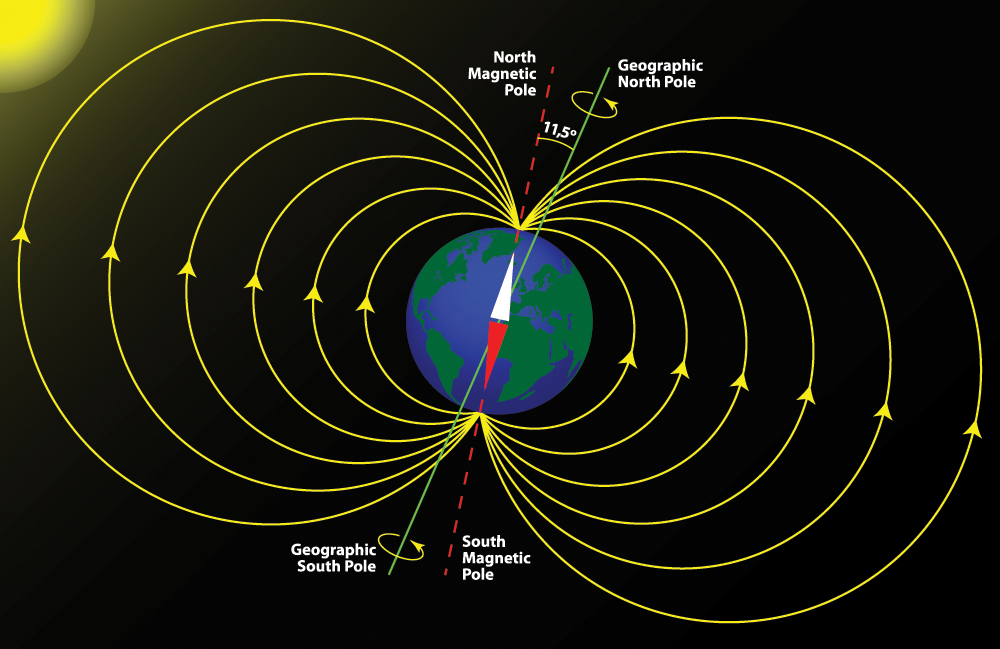
The solution to a long-standing puzzle, why magnetic north sits off the coast of Canada, rather than at the North Pole, may have been found in the strange, lopsided nature of Earth's inner core.

The inner core is a ball of solid iron about 760 miles (1,220 kilometers) wide. It is surrounded by a liquid outer core (mostly iron and nickel), a rocky, viscous mantle layer and a thin, solid crust.

The Earth's magnetic field, magnetic poles and geographic poles.
CREDIT: Earth's Magnetic Field image via Shutterstock

As the inner core cools, crystallizing iron releases impurities, sending lighter molten material into the liquid outer core. This upwelling, combined with the Earth's rotation, drives convection, forcing the molten metal into whirling vortices. These vortices stretch and twist magnetic field lines, creating Earth’s magnetic field. Currently, the center of the field, called an axis, emerges in the Arctic Ocean west of Ellesmere Island, about 300 miles (500 kilometers) from the geographic North Pole.

In the last decade, seismic waves from earthquakes revealed the inner core looks like a navel orange, bulging slightly more on its western half. Geoscientists recently explainedthe asymmetry by proposing a convective loop: The inner core might be crystallizing on one half and melting on the other.

Peter Olson and Renaud Deguen, geophysicists at Johns Hopkins University, set out to test this theory, called translational instability. They ran numerical models simulating the forces that generate Earth’s magnetic field, and included a lopsided inner core.

Olson and Deguen found that adding inner-core asymmetry shifted magnetic north away from the center of the Earth, into the cooling hemisphere. Convection was stronger there, as was the magnetic field.

"The lopsided growth of the inner core makes convection in the outer core a little bit lopsided, and that then induces the geomagnetic field to have this lopsided or eccentric character too," Olson told OurAmazingPlanet. Olson and Deguen's research was detailed online July 1 in the journal Nature Geoscience.

Geophysicist Bruce Buffett said Olson and Deguen’s research is intriguing, but there are still questions about the underlying theory. "It's an interesting result, but we don't know for sure the inner core is translating. The model does a good job at explaining some but not all of the features of the inner core," said Buffett, a professor at the University of California, Berkeley, who was not involved with the research.

Olson points out that his numerical model offers a real-world proof of the theory. Magnetic particles trapped and aligned in rocks reveal that the magnetic north pole wandered around the Western Hemisphere over the past 10,000 years, and circled the Eastern Hemisphere before that — a result mirrored by the numerical test. Gathering a longer, more detailed record of the magnetic field's behavior, Olson said, could reveal whether the inner core acts as researchers predict.

"The key question for interesting ideas like translational instability is, 'Can we test it?'" Olson said. "What we're doing is proposing a test, and we think it's a good test because people can go out and look for eccentricity in the rock record and that will either confirm or shoot down this idea."

This article was provided by OurAmazingPlanet, a sister site to LiveScience.
Article written by Becky Oskin, OurAmazingPlanet Contributor

Handmade Jewellery

With the Jubilee celebrations, Euro 2012, Wimbledon and now the lead up to the Olympic Games, this year has had more call for Britishness and celebrational spirit than any other year so far!  So why not get into the spirit with Magnetic Therapy and get your blue, red and white Pandora style bracelet, but with magnetic beads to also give you added magnetic therapy benefits!


The Olympian Magnetic Therapy Bracelet


Perhaps looking for a slightly different style of bracelet, no problem!  Try our London Links style bracelets, like our Sweetie Charm bracelets!

Sweetie Charm Bracelet - Fuchsia


As all hand made bracelets are just that, hand made, these bracelets are limited in distribution.  This means that not only are you less likely to bump into someone with the same designed bracelet as you, but the limitation also makes these bracelets unique unlike other brands readily available off street vendors.  

Also, these bracelets are gauranteed MADE IN SCOTLAND!  Stylish, trendy and all the rage, get your hand made bracelet from Magnetic Therapy now and combine style with the benefits of magnetic therapy. 


Thursday, 10 May 2012

Pandora style jewellery

Pandora-style jewellery allows ladies to create their own fashion statement; by mixing and matching beads and charms you can create a piece of jewellery that is unique.  Family and friends can give gifts of a unique bead, perhaps engraved with a message, that can be added to the bracelet as a keepsake. Pandora-style jewellery is not just about style – it is also about your life and loves!

Browse our full range of Pandora handmade bracelets now

Our magnetic Pandora-style bracelets are ready-to-wear,  but that doesn’t mean you can’t get creative. It just means you can add and replace beads and charms whenever you like.  And what’s best of all, you don’t need to buy all your beads and charms from the same outlet/shop, as long as the charm or bead fits around your bracelet you can search anywhere for your bead or charm.  With some companies releasing country only specific charms, make the world your playground as you search for unique and different charms  in different areas in different parts of the world!


And as charms and beads can vary greatly in shape and size, so does the price, therefore making the Pandora jewellery suitable for all price ranges.  So splash out or not, your choice.

What's more, Magnetic Therapy Pandora bracelets are all handmade, and contain magnetic beads - not currently found anywhere else in the world.  Therefore you will be receiving not only a limited edition piece of jewellery but also have the bonus of receiving magnetic therapy from them too.   With many to choose from, why not browse Magnetic Therapy bracelets now!?   


Monday, 30 April 2012

Magnetic Shamballa Bracelet

Choose our affordable magnetic Shamballa bracelets for the ultimate blend of celebrity fashion and Magnetic Therapy. Beyonce and the Kardashians love them, and no other accessory is this hot right now! 


Wednesday, 7 March 2012

Foot Pain and Problems

Anatomy of the foot:


The foot is one of the most complex parts of the body, consisting of 28 bones connected by numerous joints, muscles, tendons, and ligaments. The foot is susceptible to many stresses. Foot pain and problems can cause pain, inflammation, or injury, resulting in limited movement and mobility.


What are the different types of foot problems?

Foot pain is often caused by improper foot function. Improperly fitted shoes can worsen and, in some cases, cause foot problems. Shoes that fit properly and give good arch support can prevent irritation to the foot joints and skin. There are many types of foot problems that affect the heels, toes, nerves, tendons, ligaments, and joints of the foot.
The symptoms of foot problems may resemble other medical conditions and problems. Always consult your physician for a diagnosis.

What are heel spurs?


A heel spur is a bone growth on the heel bone. It is usually located on the underside of the heel bone where it attaches to the plantar fascia, a long band of connective tissue running from the heel to the ball of the foot. This connective tissue holds the arch together and acts as a shock absorber during activity. If the plantar fascia is over-stretched from running, wearing poor-fitting shoes, or being overweight, pain can result from the stress and inflammation of the tissue pulling on the bone. Over time, the body builds extra bone in response to this stress resulting in heel spurs. Treatment options may include:
  • rest
  • cold packs
  • anti-inflammatory medication such as ibuprofen
  • proper stretching prior to activity
  • proper footwear or shoe inserts
  • corticosteroid injections
  • surgery (for more severe, prolonged conditions)


What is a corn?

Corns are yellowish, callus growths that develop on top of the toes. Corns develop because of abuse or stress. Often, a corn develops where a toe rubs against a shoe or another toe. Corns can cause extreme discomfort and pain. Treatment may include:
  • trimming the corn by shaving the layers of dead skin
  • applying pads around the corn area
  • wearing larger shoes to comfortably fit your foot without rubbing
  • surgery
To avoid corn development, always purchase footwear that fits properly.


What is a bunion?

A bunion is a protrusion of bone or tissue around a joint. Bunions may occur at the base of the great toe or at the base of the little toe, and often occur when the joint is stressed over a period of time. Women are more frequently affected because they may wear tight, pointed, and confining shoes. Bunions can also be a result of arthritis which often affects the big toe joint.
Treatment of bunions may vary depending on the pain and deformity. Treatment may include:
  • wearing comfortable, well-fitting footwear (particularly shoes that conform to the shape of the foot and do not cause pressure areas)
  • surgery (for pain, not for cosmetic purposes)
  • applying pads to the affected area
  • medication such as ibuprofen


What is Morton's neuroma?

Morton's neuroma is a build-up of benign (non-cancerous) tissue in the nerves running between the long bones of the foot. Morton's neuroma occurs when two bones rub together and squeeze the nerve between them. Most often, neuromas develop between the bones leading to the third and fourth toes. Morton's neuroma often causes swelling, tenderness, and pain. If the pain becomes severe, it may cause tingling, numbness, and burning in the toes. It usually occurs after standing or walking for a long period of time. Treatment for this condition may involve rest and/or a change in footwear that does not restrict the foot. If the problem persists, cortisone injections and/or surgery may be considered.


What are hammertoes?

A hammertoe is a condition in which the toe buckles, causing the middle joint of the affected toe to poke out. This condition is often aggravated by tight-fitting shoes that put pressure on the hammertoe. Often a corn develops at this site. Treatment for hammertoes may include:
  • applying a toe pad specially positioned over the bony protrusion
  • changing your footwear to accommodate the deformed toe
  • surgical removal


What is an ankle sprain?

An ankle sprain is an injury to the ligaments in the ankle. Ligaments are tough bands of elastic tissue that connect bones to each other. Ankle sprains may occur if the ankle rolls, turns, or twists beyond its normal range of motion. Ankle sprains may be caused by awkward foot placement, irregular surfaces, weak muscles, loose ligaments, or wearing shoes with spiked heels. The symptoms of a sprain will depend on how severely the ligaments are stretched or torn but usually include swelling, pain, or bruising. Treatment will depend on the severity of the sprain and may include:
  • resting the ankle
  • wrapping the ankle with elastic bandage or tape
  • ice pack application (to reduce inflammation)
  • elevating the ankle
  • gradual return to walking and exercise
  • a walking cast (for moderate sprains)
  • surgery (for severe sprains)
  • physical therapy


What is a foot fracture?

With 26 bones in a single foot, almost any of them can be broken. Many fractures do not require surgery, or even a cast, as they will heal on their own with some support. When a foot is fractured, the site of the fracture usually is painful and swollen. The site of the fracture will determine the course of treatment, if necessary, including the following:
  • ankle joint fractures
    These fractures may be serious and require immediate medical attention. Ankle fractures usually require a cast, and some may require surgery if the bones are too separated or misaligned.
  • metatarsal bone fractures
    Fractures of the metatarsal bones, located in the middle of the foot, often do not require a cast. A stiff-soled shoe may be all that is needed for support as the foot heals. Sometimes, surgery is needed to correct misaligned bones or fractured segments.
  • sesamoid bone fractures
    The sesamoid bones are two small, round bones at the end of the metatarsal bone of the big toe. Usually, padded soles can help relieve pain. However, sometimes, the sesamoid bone may have to be surgically removed.
  • toe fractures
    Fractures of the toes normally can heal with or without a cast.


What is foot pain?

Foot pain can be debilitating to an active lifestyle. Foot pain can have many sources, from fractures and sprains to nerve damage. Listed below are three common areas of pain in the foot and their causes:
  • pain in the ball of the foot
    Pain in the ball of the foot, located on the bottom of the foot behind the toes, may be caused by nerve or joint damage in that area. In addition, a benign (non-cancerous) growth, such as Morton's neuroma, may cause the pain. Corticosteroid injections and wearing supportive shoe inserts may help relieve the pain. Sometimes, surgery is necessary.
  • plantar fasciitis
    Plantar fasciitis is characterized by severe pain in the heel of the foot, especially when standing up after resting. The condition is due to an overuse injury of the sole surface (plantar) of the foot and results in inflammation of the fascia, a tough, fibrous band of tissue that connects the heel bone to the base of the toes. Plantar fasciitis is more common in women, people who are overweight, people with occupations that require a lot of walking or standing on hard surfaces, people with flat feet, and people with high arches. Walking or running, especially with tight calf muscles, may also cause the condition.
    Treatment may include:
    • rest
    • ice pack applications
    • nonsteroidal anti-inflammatory medications
    • stretching exercises of the Achilles tendons and plantar fascia
  • Achilles tendon injury
    The Achilles tendon is the largest tendon in the human body. It connects the calf muscle to the heel bone. However, this tendon is also the most common site of rupture or tendonitis, an inflammation of the tendon due to overuse. Achilles tendonitis is caused by overuse of the tendon and calf muscles. Symptoms may include mild pain after exercise that worsens gradually, stiffness that disappears after the tendon warms up, and swelling. Treatment may include:
    • rest
    • nonsteroidal anti-inflammatory medications
    • supportive devices and/or bandages for the muscle and tendon
    • stretching
    • massage
    • ultrasound
    • strengthening exercises
    • surgery

Wednesday, 29 February 2012

Magnets Can Manipulate Morality

Magnetic fields targeting the moral center of the brain could scramble our sense of right and wrong.

Magnets were able to temporarily distort
the participants' perception of morality.

Liane Young, Massachusetts Institute of Technology
THE GIST:
  • Strong magnetic fields could affect moral judgment.
  • Targeted magnetic fields can make people more inclined to judge outcomes, not intentions.
  • The findings could have implications for neuroscience, as well as the legal system.


Magnets can alter a person's sense of morality, according to a new report in the Proceedings of the National Academy of Sciences.


Using a powerful magnetic field, scientists from MIT, Harvard University and Beth Israel Deaconess Medical Center are able to scramble the moral center of the brain, making it more difficult for people to separate innocent intentions from harmful outcomes. The research could have big implications for not only neuroscientists, but also for judges and juries.

"It's one thing to 'know' that we'll find morality in the brain," said Liane Young, a scientist at MIT and co-author of the article. "It's another to 'knock out' that brain area and change people's moral judgments."

Before the scientists could alter the brain's moral center, they first had to find it.

Young and her colleagues used functional magnetic resonance imaging to locate an area of the brain known as the right temporo-parietal junction (RTPJ) which other studies had previously related to moral judgments. While muscle movement, language and even memory are found in the same place in each individual, the RTPJ, located behind and above the ear, resides in a slightly different location in each person.

For their experiment, the scientists had 20 subjects read several dozen different stories about people with good or bad intentions that resulted in a variety of outcomes.

One typical story was about a boyfriend who leads his girlfriend across a bridge. In some versions, the boyfriend harmlessly walked his girlfriend across the bridge with no ill effect. In other cases, the boyfriend intentionally led the girlfriend along so she would break her ankle. The subjects used a seven point scale -- one being forbidden and seven completely permissible -- to record whether they through the situation was morally acceptable or not.

While the subjects read the story, the scientists applied a magnetic field using a method known as transcranial magnetic stimulation. The magnetic fields created confusion in the neurons that make up the RTPJ, said Young, causing them to fire off electrical pulses chaotically.

The confusion in the brain made it harder for subjects to interpret the boyfriend's intent, said Young, and instead made the subjects focus solely on the situation's outcome. The effect was temporary and safe.
When no magnetic field was applied, the subjects focused more on the boyfriend's good intentions, rather than a bad outcome. When a magnetic field was applied to the RTPJ, the subjects consistently focused on a bad outcome, rather than the intention, and rated the story as more morally objectionable.

The scientists didn't permanently remove the subjects moral sensibilities. On the scientists' seven point scale, the difference was about one point and averaged out to about a 15 percent change. It's not much, said Young, "but it's still striking to see such a change in such high level behavior as moral decision-making." Young also points out that the study was correlation; their work only links the the RTJP, morality and magnetic fields, but doesn't definitively prove that one causes another.

The research could have powerful implications not just for neuroscientists, but for lawyers as well. Everyday jurors are asked to weigh a person's actions against their intentions. This new study won't transform the legal field, said Owen Jones, a professor of law and biology at Vanderbilt University, but it could "enable sophisticated judgments about responsibility, harm and appropriate punishment."

"This study, and other recent studies like it, are enabling us to peer into the very brain activity that underlies and enables legal judgments," said Jones. "Understanding how legal decisions actually work is a potentially important step toward helping decisions be as fair, just and effective as they can be."

What the new research won't do is allow a jury, or even an individual, to unwittingly manipulated to favor prosecutors or defendants. Because it was so obvious that the magnets were turned on, it is unlikely that a person or a group, like a jury, could be swayed to consider a criminal outcome instead of intent, said Young.
Magnetic fields made people judge outcomes more than intentions. Whether it's possible to do the opposite -- making people focus more on intentions than outcomes -- Young doesn't know.

Article by By Eric Bland for Discovery News


Thursday, 23 February 2012

'Magnetic electricity' discovered

Photo: S Bramwell

Researchers have discovered a magnetic equivalent to electricity: single magnetic charges that can behave and interact like electrical ones.

The work is the first to make use of the magnetic monopoles that exist in special crystals known as spin ice.
Writing in Nature journal, a team showed that monopoles gather to form a "magnetic current" like electricity.
The phenomenon, dubbed "magnetricity", could be used in magnetic storage or in computing.
Magnetic monopoles were first predicted to exist over a century ago, as a perfect analogue to electric charges.

Although there are protons and electrons with net positive and negative electric charges, there were no particles in existence which carry magnetic charges. Rather, every magnet has a "north" and "south" pole.

Current event
In September this year, two research groups independently reported the existence of monopoles - "particles" which carry an overall magnetic charge. But they exist only in the spin ice crystals.

These crystals are made up of pyramids of charged atoms, or ions, arranged in such a way that when cooled to exceptionally low temperatures, the materials show tiny, discrete packets of magnetic charge.

Now one of those teams has gone on to show that these "quasi-particles" of magnetic charge can move together, forming a magnetic current just like the electric current formed by moving electrons.

They did so by using sub-atomic particles called muons, created at the Science and Technology Facilities Council's (STFC) ISIS neutron and muon source near Oxford.

The muons decay millionths of a second after their production into other sub-atomic particles. But the direction in which these resulting particles fly off is an indicator of the magnetic field in a tiny region around the muons.

The team, led by Stephen Bramwell, from the London Centre for Nanotechnology, implanted these muons into spin ice to demonstrate how the magnetic monopoles moved around.

The loops of a magnetic field can be seen in the
arrangement of iron filings
Photo: SPL
They showed that when the spin ice was placed in a magnetic field, the monopoles piled up on one side - just like electrons would pile up when placed in an electric field.

Professor Bramwell told BBC News that the development is unlikely to catch on as a means of providing energy, not least because the particles travel only inside spin ices.

"We're not going to be seeing a magnetic light bulb or anything like that," he said.

But by engineering different spin ice
materials to modify the ways monopoles move through them, the materials might in future be used in "magnetic memory" storage devices or in spintronics - a field which could boost future computing power.


Article by By Jason Palmer
Science and technology reporter, BBC News 

Friday, 3 February 2012

Magnetic Therapy: how and why magnets effect the body


Have you ever read or have been told that "it is not known why magnets work"? Well, this is untrue. All human and animal bodies are electromagnetic in nature and this fact is closely allied to the chemical balance of the body which can be in either a healthy or an unhealthy state.

It is now known scientifically that a healthy body contains fluids that are slightly alkaline and that an unhealthy body is acidic. A poor diet can make the body acidic and in this state all sorts of dis-eases will thrive. (Dr John Millward MD, "Your Life in the Balance", available on our website.)

It is also known that at damaged sites in the body, exists a positive electrical charge which affects both the chemical balance the electrical balance in the area resulting in pain. In order to effect healing, the body's own systems send a negative electrical charge to the area. (Dr Robert Becker, "The Body Electric")

This healing action of the body is easily restricted by poor diet, lifestyle, alcohol, drugs etc. There is also a lot of evidence of something called "Magnetic Deficiency Syndrome" being a major contributor to restricting the body's ability to respond to illness. I will be looking in depth at this syndrome in a later article.
  • It is now firmly established that a negative magnetic field, provided by a geomagnetic north pole magnetic field (the same as the Earth's North Pole), is the most natural way of providing much needed support for the body's own immune system.
Dr W Philpott MD, a practitioner of magnet therapy for over 40 years explains that negative magnetic fields oxygenate and alkalise by aiding the body's defences and helping to relieve pain. Further, they combat inflammation and infection and enhance deep restorative sleep.

This latter point is extremely important. In order to combat maladies that result from the stress of our current lifestyles, the correct amount of good quality sleep is essential. Combine this with the possibility of at least reducing the amount of powerful drugs taken and what results is a completely natural complementary therapy.

It is probably wise at this stage just to say that anyone reading this article that is undergoing a course of treatment with a health professional should not stop the treatment but consider using magnetic therapy in support. Also, magnetic therapy should not be used if any electronic implants are present in the body.
Given the correct choice and placement of magnetic device, this is probably the most effective alternative therapy available. Typical successful application results in 80 to 90% of cases, higher with some forms of dis-ease. Magnet therapy can be applied by you whenever and wherever needed. Modern materials technology has produced small powerful inexpensive magnets which can be used anywhere on the body and can be moved about to find the best positions. Sleeping on magnets provides a most efficacious application.
In the next article in this series, I will be looking at the subject of magnets, their strength measurement and a complete explanation of polarity.

-------------------------------------------
Barry Dench is a qualified electrical engineer, who in 1996 applied his knowledge of magnetism to research the effects of magnetic fields on the biological body. Author of "The Essential Magnetherapy Handbook" and numerous articles on the use of magnets, he can be contacted at his website:- www.magnecare.co.uk . Previous articles in this series can be found in the Article Library on the author's website.

Source: 
Barry Dench        


By Armen Hareyan for Emax Health


Tuesday, 31 January 2012

Magnetic Water – Is It For Real?


Over the last few weeks, I’ve had several queries about the benefits of drinking magnetic water. And also a fair few people saying that it’s quackery (specially those who have done their research on the web)


In this article I will try to explain how magnetic water works. And the rest is up to you, whether you decide to use it or not. First, I’ll talk about whether water can be magnetised or not, then a quick review of the possible health benefits you can gain from drinking magnetic water and finally the easiest and most effective method to magnetize water.


Browse the Water Wand from Magnetic Therapy now
Click Here!


Can water be magnetised?

Many of us understand our basic need to drink clean, healthy water. But what actually is healthy water, and why do we need it?


We are over 70% water. All our biological functions including circulation, digestion, absorption, and excretion depend on water. Water is required for blood, the lymphatic system, and healthy skin and muscles. Doctors, scientists, researchers and natural healers all agree that drinking enough water on a daily basis can help maintain good health and likely help fight disease. Most experts advise drinking at least a litre of water a day to assist in maintaining healthy skin and properly functioning kidneys, bowels, and circulation.


Water is Paramagnetic meaning that it holds a magnetic charge.

Paramagnetism occurs primarily in substances in which some or all of the individual atoms, ions, or molecules possess a permanent magnetic dipole moment. Water has a dipole moment and is, therefore, subject to paramagnetism. (At the University of Tokyo researchers were able to make water levitate using magnets.


(Source: NATURE . Ikezoe, N. Hirota, J. Nakagawa and K. Kitazawa, Making water levitate, Nature 393 (1998) 749-750).


Again, water molecules are dipolar. Since opposite electrical charges attract, water molecules tend to attract each other (Kegley and Andrews, 1998). Water in living systems naturally gathers into structures of 14, 17, 21, 196, 280, or more molecules (Mikesell, 1985; Davis, 2004). The bottom line is that structured or ionised or magnetised water can be formed using magnets (Mikesell, 1985).


There is a long history of the promotion of magnets to improve the quality and health benefits of water. Researchers found that when a permanent medical magnet is kept in contact with water, the water gets magnetically charged and acquires magnetic properties. Such magnetically treated water affects the human body when taken internally and regularly for a considerable period of time (Lam, 2001). Also, when water is magnetically treated, more hydroxyl (OH-) ions are created to form alkaline molecules, and reduce acidity. Normal water has a pH level of about 7, whereas magnetized water tends to be more alkaline.


Research has shown that it is possible to regenerate water to its original healthy state by magnetizing it. It is now clear that water has a very definite structure. A water molecule consists of two hydrogen atoms and an oxygen atom. Because of the electron configuration of the molecule the hydrogen atoms tend to attract other water molecules resulting in the formation of clusters which can contain anywhere from four to hundreds of water molecules each.


Some very exciting research done in Hungary has shown that these clusters actually have a memory and can remember and carry an imprint of the magnetic energy they have been exposed to either simply from the earth’s magnetic field or through flowing over paramagnetic rock. It is the fact that this memory is destroyed on the way to the tap which renders our drinking water lifeless.


(Zhalko-Tytarenko, Olga, et al. Endogenous electromagnetic field influence on the free energy of hydrogen bond formation in water. 2nd Advanced Water Sciences Symposium, Dallas, Texas, October 4-6, 1996. Proceedings, pp. 23-27 ).


Browse the Water Wand from Magnetic Therapy now
Click Here!


The health benefits of drinking magnetic water.


Magnetized water is claimed to be energy-building, activating, cleansing and detoxifying. There are reports of people resolving bladder problems, recovering quickly from a stroke, alleviating arthritis pain and reducing blood pressure by drinking magnetized water. It is perhaps reasonable to assume that if scientific studies on animals have proven that magnetized water has health benefits, then it should also be beneficial to humans. However, so far there have been no systematic, clinical trials done to prove or disprove the healing effects of magnetized water in humans. 


(Gursche, Siegfried and Rona, Zoltan. Encyclopedia of Natural Healing. Alive Publishing, Inc., Burnaby, Canada, 1997, pp. 400- 07 )


Here’s a list of all the claims of the potential benefits of drinking magnetic water:
  • Magnetized water tastes sweeter and has more clarity.
  • Magnetic water promotes a more alkaline pH in the body
  • Magnetic water promotes healing of wounds and burns
  • Magnetic water has a therapeutic effect on digestive, nervous and urinary systems
  • Magnetic water may also be beneficial for fevers, sore throat, menstrual and menopause discomfort.
  • Magnetic water revitalizes the body
  • Magnetic water provides positive effect on the autonomic nervous system
  • Magnetized water has been reported to help regulate the heart function and clear clogged arteries
  • Magnetic water has been beneficial for kidney ailments, gout, obesity and premature aging
  • Magnetic water may help relieve pain
  • Magnetic water infuses energy into the body, controls bacteria, and stimulates brain function.
Whether these claims are true or false remains to be tested by science. It will be decades before the science of magnetized water is fully understood. Those in mainstream medicine may discount magnetized water “quackery”. That in the forefront of magnetic research paints a different story. If one understands and accepts that each of our cells possesses a small magnetic field, as many research studies are now supporting, the logical conclusion that magnetic water has the ability to affect our cells must be taken seriously.


What we believe is the most efficient way to magnetise drinking water.
Water Wand from Magnetic Therapy


We promote using a bipolar magnetic water wand to magnetise water. It is a quick, efficient, simple and cost effective method. Here’s some more data about the water wand. 


The magnetic water wand is 14cm (5¾ inch) long and looks like a pen with a ceramic ball at the end. The long lasting, lime scale resistant rhodium coating protects the 2 bipolar, magnets inside, totalling 2300 gauss (230 m Tesla). Because you are actually placing the magnets directly into the water the magnetic field penetrates the water extremely quickly. To magnetise a glass of water (200 – 250 ml), leave the magnetic wand for 10 to 15 minutes. and to magnetise a litre, we recommend leaving the magnetic water wand for an hour.


Remember, you don’t have to drink ONLY water. You can magnetise any cold fluid with the water wand!


Do you agree with the statements made above? leave your comments


Article by Debbie Shimadry for SelfGrowth.com


Browse the Water Wand from Magnetic Therapy now
Click Here!