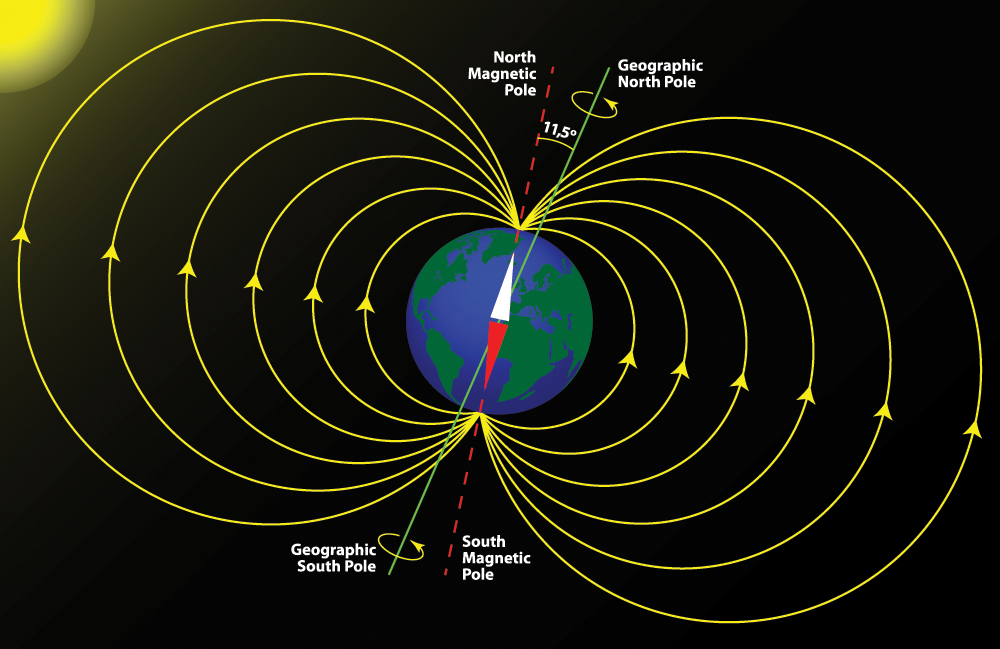
The solution to a long-standing puzzle, why magnetic north sits off the
coast of Canada, rather than at the North Pole, may have been found in
the strange, lopsided nature of Earth's inner core.
The inner core is a ball of solid iron about 760 miles (1,220
kilometers) wide. It is surrounded by a liquid outer core (mostly iron
and nickel), a rocky, viscous mantle layer and a thin, solid crust.
As the inner core cools, crystallizing iron releases impurities,
sending lighter molten material into the liquid outer core. This
upwelling, combined with the Earth's rotation, drives convection,
forcing the molten metal into whirling vortices. These vortices stretch
and twist magnetic field lines, creating
Earth’s magnetic field.
Currently, the center of the field, called an axis, emerges in the
Arctic Ocean west of Ellesmere Island, about 300 miles (500 kilometers)
from the
geographic North Pole.
In the last decade, seismic waves from earthquakes revealed the inner
core looks like a navel orange, bulging slightly more on its western
half. Geoscientists recently explainedthe asymmetry by proposing a
convective loop: The
inner core might be crystallizing on one half and melting on the other.
Peter Olson and Renaud Deguen, geophysicists at Johns Hopkins
University, set out to test this theory, called translational
instability. They ran numerical models simulating the forces that
generate Earth’s magnetic field, and included a lopsided inner core.
Olson and Deguen found that adding inner-core asymmetry shifted
magnetic north away from the center of the Earth, into the cooling
hemisphere. Convection was stronger there, as was the magnetic field.
"The lopsided growth of the inner core makes convection in the outer
core a little bit lopsided, and that then induces the geomagnetic field
to have this lopsided or eccentric character too," Olson told
OurAmazingPlanet. Olson and Deguen's research was detailed online July 1
in the journal Nature Geoscience.
Geophysicist Bruce Buffett said Olson and Deguen’s research is
intriguing, but there are still questions about the underlying theory.
"It's an interesting result, but we don't know for sure the inner core
is translating. The model does a good job at explaining some but not all
of the features of the inner core," said Buffett, a professor at the
University of California, Berkeley, who was not involved with the
research.
Olson points out that his numerical model offers a real-world proof of
the theory. Magnetic particles trapped and aligned in rocks reveal that
the magnetic north pole wandered around the Western Hemisphere over the
past 10,000 years, and circled the Eastern Hemisphere before that — a
result mirrored by the numerical test. Gathering a longer, more detailed
record of the
magnetic field's behavior, Olson said, could reveal whether the inner core acts as researchers predict.
"The key question for interesting ideas like translational instability
is, 'Can we test it?'" Olson said. "What we're doing is proposing a
test, and we think it's a good test because people can go out and look
for eccentricity in the rock record and that will either confirm or
shoot down this idea."
This article was provided by OurAmazingPlanet, a sister site to LiveScience.
Article written by Becky Oskin, OurAmazingPlanet Contributor